 Landon Curt Noll
96e0f2b966
A number of rules have been moved from entry `Makefile`s into the
`1337.mk` include file to make it easier for these common rules to be
updated or modified globally (by modifying the `1337.mk` include file).

The entry level `Makefile`s are now similar in form to the
/Makefile.example](https://github.com/ioccc-src/mkiocccentry/blob/master/Makefile.example)
file from the other repo.

The following make rules were moved into the `1337.mk` include file:

- `make indent.c`
- `make install`
- `make diff_orig_prog`
- `make diff_prog_orig`
- `make diff_alt_prog`
- `make diff_prog_alt`

This simplifies the entry level `Makefile`s so that they mostly reflect
the specifics of the particular entry.

Mentioned in FAQ 4.2, that the make diff rules are in the `1337.mk` include file.

Fixed invalid TAB character in `faq.md`.

Removed `make clean` directives that removed `indent.c`.  This file is now
removed via `make indent_clean`, a clean rule that also removes `indent.c`.

Removed `make clobber` directives that removed sandwich,  This file is now
removed via `make indent_clobber`, a clean rule that also removes `sandwich`.

Added `make indent_clean` and `make indent_clobber` rules into the top level
`Makefile` and the year level `YYYY/Makefile`.

Performed `make quick_www` to accomplish the above and to test under macOS.

To build:
make
There is an alternate version that should work with Windows. See Alternate code below.
To use:
./prog > lena.ppm
Try:
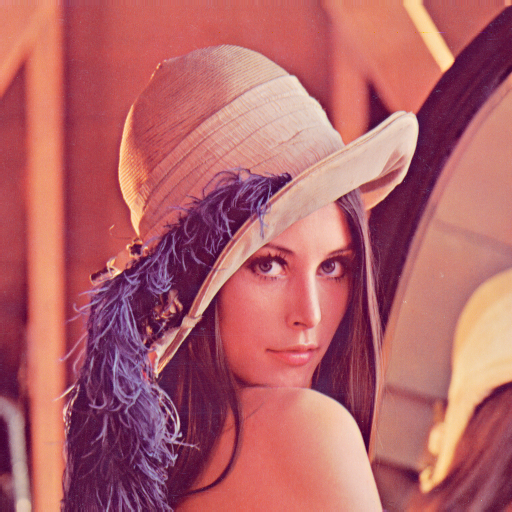
First open Lenna.png in your graphics viewer of choice. Next, after
running the above command (./prog > lena.ppm), open lena.ppm in your
graphics viewer of choice. After that try:
./try.sh
NOTE: the script uses the tools pngtopam(1) (or pngtopnm(1) for older
versions) and pnmscale come from the netpbm project and cjpeg(1) comes from
libjpeg-turbo. If you don't have these tools already see the
FAQ on "netpbm"
and the
FAQ on "libjpeg-turbo".
NOTE: Lenna.png is from https://upload.wikimedia.org/wikipedia/en/7/7d/Lenna_%28test_image%29.png.
Alternate code:
The prog.alt.c is based on the author's remarks and it should work for Windows.
Alternate build:
make alt
Alternate use:
Use prog.alt as you would prog.
Judges' remarks:
The file small.jpg will be approximately of the same size as the raw image
data in the program. Compare the level of the detail and the artifacts of
small.jpg and lena.ppm.
Compressing images is just a matter of simple arithmetic and some magic, isn't it?
We could understand some of the arithmetic but none of the magic.
Deciphering the mechanism used for data encoding to make use of whitespace, braces and semicolons should be a slightly easier task.
Author's remarks:
Warning: the program is not protected against invalid input.
This program outputs a 128x128 RGB image file to the standard output using the portable pixmap file format (PPM). It contains the famous "Lena" image which is used in many image compression tests.
The uncompressed image is 12 times larger than the source code of the program which includes the image data and the complete decoder. The actual image data is 1220 byte long, which gives a compression ratio of 40. Using a JPEG-like algorithm would not be enough to reach this level of compression (the Lena image would be barely recognizable). So the algorithm is based on the latest advances in image compression. It includes the following features:
- DCT transform with variable block size (4x4, 8x8, 16x16 and 32x32)
- DC and directional predictors
- arithmetic coding
- YCgCo color space.
The image data is encoded to a C string with some tricks to make the best use of the IOCCC size constraints. The identifiers were shortened to a single letter to save space. No specific obfuscation was needed as the algorithms already have a significant complexity.
Although the program was optimized to decompress its built-in image, it accepts to decompress image files from its standard input. Examples:
    ./prog d < lena512.bin > lena512.ppm
    ./prog d < fruits.bin > fruits.ppm
    ./prog d < vintage_cars.bin > vintage_cars.ppm
The original images for fruits and vintage cars come from Wikipedia and were resized to a width of 1024 pixels.


The program should be portable on any Unix system. On Windows the line
_setmode(0, 32768); _setmode(1, 32768); must be added at the start of
the main() function to avoid unwanted carriage return characters in
the output.